

What Happens In The First Year After You Stop Drinking?
2025-11-23
What is insulin resistance? How does it affect our weight?
2026-03-07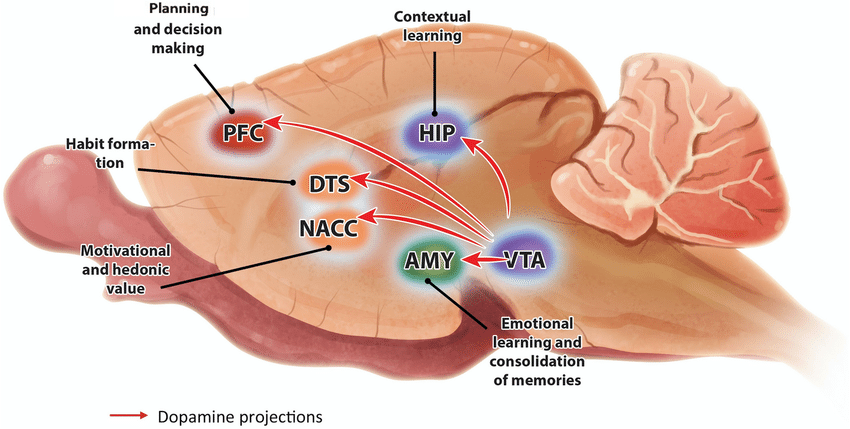
Addiction is not just about liking a substance or behaviour. It is a chronic, relapsing brain condition in which the motivation to seek a reward becomes compulsive despite harm. At its core are learning and memory processes that reshape the brain’s motivational systems. Neurotransmitters—chemical messengers that let neurons communicate—govern how we experience pleasure, stress, habit, and self-control. In addiction, their balance and timing are altered, producing powerful cravings, diminished sensitivity to everyday rewards, and difficulty stopping use.
The reward circuit in brief
When something unexpectedly good happens, dopamine neurons in the ventral tegmental area (VTA) fire in brief bursts and release dopamine into the nucleus accumbens (NAc), prefrontal cortex (PFC), amygdala, and other regions. This phasic dopamine signal encodes a “prediction error”—a teaching signal that updates what we learn to want and where to direct attention. Over time, cues that predict reward can themselves trigger dopamine bursts and drive approach behaviour. That is normal reinforcement learning.
Drugs of abuse hijack this system by producing dopamine surges far exceeding natural rewards or by amplifying dopamine’s teaching signal at the wrong times. Repeated exposure reshapes synapses and circuits so that drug-related cues and contexts grab attention, evoke craving, and bias decision-making toward use.
From use to addiction: a cycle of three stages
Many researchers describe addiction as cycling through three overlapping stages, each with its own dominant neurochemistry:
-
Withdrawal/negative affect:
As the drug leaves the system, anti-reward and stress systems dominate, producing anxiety, dysphoria, and irritability.
-
Preoccupation/anticipation (craving):
Glutamate-driven circuits linking the prefrontal cortex, hippocampus, and amygdala to the striatum become hyper-responsive to cues, stress, and drug memories, increasing relapse risk.
Binge/intoxication:
Heightened reward signaling (dopamine, endogenous opioids) promotes consumption and learning of drug-cue associations.
Key neurotransmitters and what they do in addiction
Dopamine
Often misnamed the “pleasure chemical,” dopamine is primarily about learning, motivation, and the vigor of goal-directed behaviour. All addictive drugs, directly or indirectly, increase dopamine in the NAc. Stimulants such as cocaine block the dopamine transporter (DAT), and amphetamines reverse it and disrupt vesicular storage (VMAT2), causing large surges. Opioids, alcohol, cannabis, and nicotine increase dopamine indirectly, often by disinhibiting VTA dopamine cells. Over time, baseline dopamine tone can drop and D2 receptor availability can decrease, contributing to reduced sensitivity to everyday rewards and increased reliance on the drug to feel “normal.” Dopamine also assigns incentive salience—turning cues into “wanting” signals—even when “liking” (hedonic pleasure) wanes.
Glutamate
The brain’s main excitatory transmitter underlies learning and memory. In addiction, glutamate pathways from the PFC, amygdala, and hippocampus to the NAc become biased toward drug-seeking. Synapses strengthen or weaken (LTP/LTD), AMPA/NMDA receptor ratios shift, and new spines form on accumbens neurons. These changes make drug cues powerful triggers and weaken top-down control. Glutamate dysregulation is central to relapse; treatments like acamprosate (for alcohol) and experimental agents target glutamatergic balance.
GABA
The principal inhibitory transmitter. Many addictive drugs enhance GABA-A receptor function (e.g., benzodiazepines, barbiturates, alcohol), which initially reduces anxiety and produces sedation. In the VTA, opioids, cannabinoids, and benzodiazepines can inhibit local GABA interneurons, disinhibiting dopamine cells and boosting dopamine release. During withdrawal, GABA/glutamate balance flips toward hyperexcitability, raising seizure risk with alcohol or benzodiazepine cessation.
Endogenous opioids (endorphins, enkephalins, dynorphin)
Mu-opioid receptor activation increases hedonic impact and facilitates dopamine release; this underpins the intense euphoria from opioid drugs. Chronic use downregulates opioid signaling, producing tolerance and a severe withdrawal syndrome.
Serotonin
Modulates mood, impulse control, satiety, and the timing of dopamine signals. Serotonin deficits can worsen impulsivity and depressive symptoms that fuel use and relapse. Serotonergic drugs like MDMA release serotonin and alter social reward processing; chronic disruption can affect mood and cognition. Standard antidepressants are not anti-addiction drugs, but treating co-occurring depression can improve outcomes.
Endocannabinoids (anandamide, 2-AG)
Retrograde messengers that fine-tune synaptic transmission by acting on CB1 receptors to reduce GABA or glutamate release. THC activates the same receptors broadly, altering reward, stress, and memory circuits. Endocannabinoid tone shapes how strongly cues are encoded and how stressful states bias behaviour.
Circuits: from goal-directed action to habit
Early in use, the ventral striatum (NAc) and orbitofrontal/medial prefrontal cortex support flexible, outcome-sensitive choice. With repetition, control shifts toward the dorsal striatum, which encodes habits supported by sensorimotor loops. Basically, cue and context circuits become over-strengthened for drug associations; prefrontal control weakens, especially under stress or sleep loss; and Dopamine bursts become tied to predictive cues rather than the drug itself, making the environment a trigger. That’s when you feel like needing the drug in your daily life. It is no longer an agent for hedonic pleasure but the one to maintain your normal functioning.
How different drugs tap the same systems
-
Opioids (heroin, fentanyl, prescription opioids):
Activate mu-opioid receptors, causing euphoria and analgesia, disinhibit VTA dopamine neurons, and produce severe physiological dependence via adaptations across opioid and noradrenergic systems.
-
Alcohol:
A pharmacological “dirty” drug that enhances GABA-A, inhibits NMDA, increases endogenous opioid release, and boosts dopamine indirectly. Withdrawal can be medically dangerous due to hyperexcitability.
-
Nicotine:
Partial/full agonist at nicotinic receptors; quickly potentiates dopamine neuron firing and releases dopamine in the NAc. High relapse rates reflect strong cue pairing and withdrawal irritability/dysphoria.
-
Cannabis:
THC activates CB1 receptors widely, modulating both GABA and glutamate release; effects on motivation, memory, and reward vary with dose, potency, and age of onset.
Stimulants (cocaine, methamphetamine):
Directly raise synaptic dopamine (and often norepinephrine) to unusually high levels, strongly reinforcing drug-cue learning and producing sensitization of incentive salience.
Behavioural addictions
Gambling, gaming, and certain compulsive behaviours can engage the same learning and salience systems without an external drug. Cues, intermittent rewards, and stress shape dopamine and glutamate-driven habits similarly, though the physiological dependence profile differs.
Treatment: translating neurochemistry into care
No single treatment undoes all these changes, but combining medications, psychosocial support, and harm reduction addresses different parts of the cycle.
Medications such as Methadone for opioids, Naltrexone for alcohol, Nicotine replacement for tobacco, or alpha-2 agonists (clonidine, lofexidine) for noradrenergic withdrawal symptoms can help to target the neuro-disfunction in different substance addictions.
Psychosocial interventions, such as
-
- Cognitive-behavioural therapy to build coping skills and restructure cue-driven thinking.
-
- Contingency management uses positive reinforcement to shift learning toward healthy behaviours.
-
- Motivational interviewing enhances readiness to change; peer recovery and mutual-help groups provide social reinforcement.
-
- Addressing sleep, stress management, pain, housing, and employment strengthens prefrontal control and reduces triggers.
Recovery and brain plasticity
The same plasticity that supports addiction also supports recovery. With sustained abstinence or reduced use, dopamine and receptor function can partially normalize, stress systems can quiet, and prefrontal control can strengthen. Exercise, meaningful social connection, adequate sleep, and cognitively engaging activities enhance neurogenesis and plasticity, helping shift motivation back toward natural rewards.
Takeaway
Addiction reflects learned, biologically reinforced changes across multiple neurotransmitter systems and circuits. Dopamine teaches what to want; glutamate wires in the wanting; opioids and endocannabinoids tune hedonic tone; GABA and glutamate balance inhibition; stress systems push toward relief-seeking; and prefrontal circuits try—often against the tide—to steer behaviour. Effective treatment recognizes this complexity, pairing medical, psychological, and social supports to rebalance the system and create space for new learning.
A drug -free naturopathic therapy to get rid of your addiction
Once we know what is wrong in the addiction-influent brain, the effective treatment approach becomes possible. According to the traditional Chinese acupuncture and French auriculotherapy, the acupoints on the outer ears are linked to the nerve system, which stems from the brain. By stimulating different acupoints on the outer ears, treatments can be developed to target addiction issues and other psycho-emotional issues.
The Stop Centres, a naturopathic clinic specialized in low-level laser auriculotherapy with over 25 years of experience, has developed a series of treatment protocols for different kinds of addictions ranging from tobacco, alcohol, marijuana, cocaine to gambling and food addiction related appetite control. Each protocol targets brain areas and neuropathways related to the specific addiction that it addresses. The service programs are named after the targeted addictions. Therefore, you have Stop TobaccoTM, Stop AlcoholTM, Stop Soft DrugsTM, Stop Hard DrugsTM, Stop GamblingTM, Stop WeightTM and Stop AppetiteTM , as well as Stop AnxietyTM, Stop StressTM, and Stop InsomniaTM. Each program consists of physical soft laser auricular therapy and emotion supporting life coaching. We help you re-balance the neurotransmitters in the brain in a drug free healthy way and take control of your own life again.

